 Arcdh Arc – Association for Human Rights of Azerbaijanis of Iran "ArcDH"

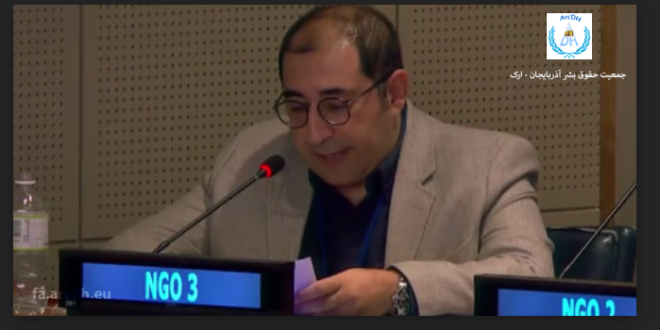
At the 70th session of the Commission on the Status of Women (CSW70), held at United Nations Headquarters in New York, a statement delivered by Mr.Behzad Vaziri Hassas on behalf of the Association for the Defense of Human Rights of Azerbaijanis of Iran (ArcDH) drew attention to structural barriers limiting access to justice for women and girls in Iran.
The statement was presented during the 15th plenary meeting under the general discussion segment, which focused on ensuring equal access to justice and eliminating discriminatory laws and practices affecting women and girls.
ARCDH emphasized that access to justice cannot be achieved without addressing compounded forms of discrimination based on gender, language, ethnicity, and socioeconomic status. According to the statement, while all women in Iran face systemic discrimination embedded in laws and policies, Azerbaijani women and girls, along with other ethnically and linguistically marginalized groups, encounter additional and intersecting barriers that further restrict their access to rights, remedies, and protection.
A key concern raised was the denial of education in the mother tongue. The organization stated that depriving Azerbaijani girls of education in their native language undermines literacy, limits legal awareness, restricts access to information, and weakens trust in institutions. Over time, this contributes to a cycle of exclusion, reducing women’s ability to understand and claim their rights or participate fully in civic life.
The statement further highlighted the broader consequences of such structural barriers, including increased vulnerability to child and underage marriage, exploitation, and limited access to legal protection and support services. It also noted the impact of digital exclusion, which restricts non-Persian-speaking women and girls from accessing essential information on health and bodily autonomy.
Despite these challenges, ARC noted that women in Iran have played a leading role in recent uprisings, calling for dignity, equality, and freedom. The organization stressed that the courage of women from Azerbaijani and other marginalized communities must be met with protection, representation, and justice.
ARCDH called on the United Nations, Member States, and relevant international mechanisms to explicitly address the denial of mother-tongue education and related structural discrimination in Iran, urging that these rights be recognized as essential to justice, equality, and human dignity.